From shelter to temple
According to Wikipedia, the caves were first used as shelters by the Temuan people, a tribe of Orang Asli. In the 1860s Chinese settlers began digging guano from the caves for fertiliser, and in 1878 the American naturalist William Hornaday visited. K. Thamboosamy, an Indian Tamil trader, promoted the complex as a place of Hindu worship, and a temple dedicated to Murugan was completed in 1891. Wikipedia says an annual festival at the site began in 1892; we do not cover it further here, since our own interest is the history and visiting the place respectfully.
The statue
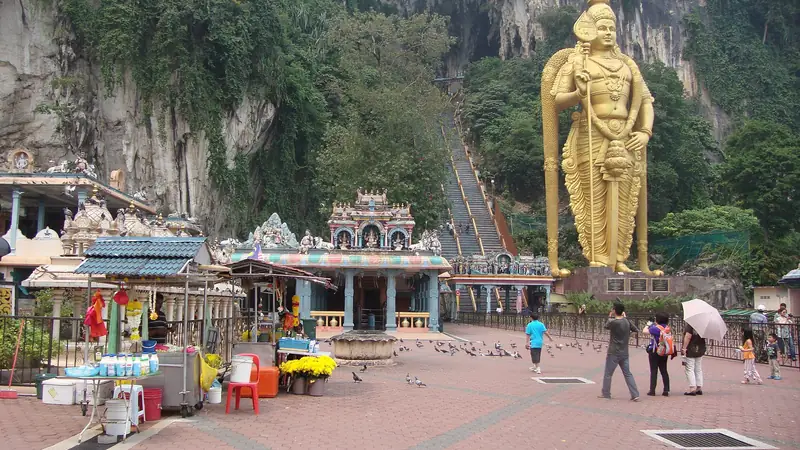
A gold-painted Murugan statue stands to the right of the steps, unveiled in January 2006. Wikipedia gives its height as 42.7 m in the text and 43 m in the introduction and calls it the tallest statue in Malaysia and among the tallest Murugan statues in the world. The steps beside it are described on the 272 steps page.
What is inside
The Subramanian Swamy temple is in the largest cave. At the base of the hill, the Art Gallery Cave and Museum Cave form the Cave Villa complex, with statues and paintings from Hindu mythology, most relating to the life of Murugan. The Ramayana Cave is to the left and holds paintings of events from the epic, with a 15 m Hanuman statue at the entrance and a Hanuman temple that opened in November 2001. Entry arrangements and any fees are not stated in our sources: see opening hours, fees and dress.
The cave system and wildlife
Wikipedia describes about 20 recognised caves, including four large systems, formed in limestone more than 400 million years old (the caves themselves are younger, perhaps 60 to 120 million years). It lists 21 bat species, many other cave animals, and long-tailed macaques. To protect the ecology, access to the inner complex is restricted and is possible on educational trips organised by the Malaysian Nature Society.
Plan the visit
Start with the Batu Caves guide, then read about the train from KL Sentral. A guided combination with Kanching Falls is also an option.
Frequently asked questions
When was the Batu Caves temple built?
Wikipedia says a Hindu temple dedicated to Murugan was completed in 1891, after K. Thamboosamy, an Indian Tamil trader, promoted the cave complex as a site of worship. Wooden steps followed in 1920 and concrete steps in 1940.
How tall is the Murugan statue at Batu Caves?
Wikipedia gives 42.7 m (140 ft) in the text and 43 m in its introduction. It was unveiled in January 2006, painted gold, and is described as the tallest statue in Malaysia.
What does Batu Caves mean?
Wikipedia says the name comes from the Malay word batu meaning rock. The hill was also called Kapal Tanggang, the ship of Si Tanggang, after a Malay folktale.
What is inside Batu Caves?
Wikipedia describes the main Murugan temple in the largest cave, the Art Gallery Cave and Museum Cave at the base, the Ramayana Cave with a 15 m statue of Hanuman at the entrance, and an inner cave system with restricted access that can be visited on educational trips by the Malaysian Nature Society.
Some links are affiliate links: if you book through them we earn a small commission at no extra cost to you. It funds the research behind this site.